Sunday, February 6, 2011

MADRAS PRESIDENCY ARCAT NAWAB COINS

Madras Presidency, also known as Madras Province and known officially as Presidency of Fort St. George, was a province of British India with capital at Madras ( now known as Chennai) and included many parts of south India :-
* Tamilnadu
* Kerala : Malabar region
* Lakshadweep
* Andhra Pradesh : Coastal Andhra and Rayalaseema
* Karnataka : Dakshina Kannada, Udupi and Bellary districts


After India's independence in 1947, Madras Presidency was reconstituted as Madras State. In 1953 the Rayalaseema and Coastal Andhra regions became the new state of Andhra, and Bellary district became part of Mysore State . In 1956, South Kanara district was transferred to Mysore, the Malabar Coast districts became part of the new state of Kerala , and Madras state, renamed Tamilnadu in 1968 , took its present shape. The northern district of Madras presidency, Ganjam, was transferred to Orissa
________________________________________________
                                 The earliest coins of the company in Madras were small silver pieces issued from their factory at Fort St. George in about 1670's. These coins were undated with two interlinked C's on the reverse (assigned to the reign of King Charles II).

During the 18th century silver coins were minted bearing the Company's bale mark(an orb and a cross) inscribed C.C.E (Charter Company of England) and in some cases G.C.E (Governor and company of merchants trading into the east Indies). All these issues were meant for use within the company's factory and surrounding areas and also for exchange with European traders. They were not meant for circulation in the interior of the country.

In 1742 company obtained permission from Nawab Sadatulla Khan of the Subah of Arcot to coin rupees in imitation of those struck at the imperial mint at Arcat. These coins were poorly struck with dies bigger than the blanks used. Hence, only a part of inscriptions are generally visible. They bear the name of Alamgir II with Sixth year of reign and have a 'lotus - mint mark'. This undated series continued for about 50 years. Subsequent issues had Hegira Date '1172' equivalent to 1758 A.D. irrespective of the year of minting. The R.Y-6 also appears on all issues.


SOME OF MY HAND MADRAS PRESIDENCY COINS 

ONE RUPEE ARCAT NAWAB SILVER LOTUS MARK COIN


ONE FANAM SILVER (VISHNU FANAM) COIN


                         In 1807 new machinery was introduced and mint produced 2 silver coin in European style with oblique milling. One series based on Hindu standard consisted of One and Two pagoda in gold, Half and Quarter pagoda and Fanams in silver. The copper coins consisted on Cash denominations.


The other series based on moghul standard were gold mohurs and fractions of mohurs : ¼, and ½ . They issued rupees together with fractions down to ⅛ and 116 rupee in silver. Madras also issued 2 rupees coins. Although minted in 1807 and later all bear the frozen date "1172"A.H.
Copper coins in this series were Faluce(Dub) with inscriptions in persian on one side and Tamil and Telugu inscriptions on the other side indicating the value in Dub units.
In Madras, there were copper coins for 2, 4 pies, 1, 2 and 4 paisa, with the first two denominated as ½ and 1 dub or 1
96 and 148 rupee. Madras also issued the Madras Fanam until 1815.

Although the two systems of coins were in circulation at the same time but they were unrelated.

3360 Cash = 42 Fanams = 1 Pagoda =31/2 Rupees = 168 Faluce (Dub)

1 Rupee = 48 Faluce (Dub)

1 Faluce (Dub) = 20 Cash; 1 Fanam = 4 Faluce(Dub) = 80 Cash

After 1818, Rupee was made the standard coin and the weight was fixed at 180 grains with smaller pieces in proportion. The pagodas and fanams were demonetized from that year.

Next issues were :-

1. 1812-1835 : Struck at Madras Mint with 'Lotus' mint mark and indented cord milling.

2. 1823-1825 : Struck at Calcutta with 'Rose' mint mark and upright milling.

3. 1830-1835 : Struck at Calcutta with 'Rose' mint mark and upright milling but with a small crescent added on the reverse (rupee and half rupee coins) and on obverse(1/4 rupee coins).

SOME OF MY COLLECTIONS


ONE RUPEE ARCAT NAWAB MADRAS PERSIDENCY SILVER COINS LOTUS MINT MARK 


ONE RUPEE ARCAT NAWAB MADRAS PERSIDENCY SILVER COINS ROSE MINT MARK


1/8TH RUPEE ARCAT NAWAB MADRAS PERSIDENCY SILVER COINS ROSE MINT MARK


1/16TH RUPEE ARCAT NAWAB MADRAS PERSIDENCY SILVER COINS ROSE MINT MARK


1/16TH RUPEE ARCAT NAWAB MADRAS PERSIDENCY SILVER COINS LOTUS MINT MARK


ABOVE IMAGES ARE FROM MY PERSONAL COLLECTIONS


PORTUGUESE INDIA COINS

The Portuguese were the first people who thought to establish their territorial dominion in India. After obtaining the approval letter from the Zamorin, the Raja of Calicut, the trade between India and Portugal began. Establishing the trade and commercial relation with India had given rise to the thought of establishing their supremacy in the eastern seas. With the indulgence of political intrigues in the Indian states, the Portuguese succeeded in establishing their settlements at Diu, Daman, Salsette, Bassein, Chaul and Bombay on the west coast, San Thome near Madras and Hooghly in Bengal. They also extended their authority over the major part of Ceylon. Later due the Portuguese lost most of their territories and by the end of the eighteenth century only Diu, Daman and Goa were in their dominion.


SOME OF MY PORTUGUESE INDIA COINS

PORTUGUESE INDIA 30 REIS OR HALF TANGA COIN


PORTUGUESE INDIA COIN ATIA YEAR 1768 


PORTUGUESE INDIA SIX REIS COIN


PORTUGUESE INDIA BAZARUCO YEAR 1698 COIN


THE ABOVE GIVEN IMAGES ARE FROM MY OWN COLLECTIONS


Tuesday, January 25, 2011

DUTCH UNITED EAST INDIA COMPANY COINS


The history of Dutch coins in India it depicts that in a span of five years no less than sixty five Dutch vessels sailed to Indies. The private companies for trade with the East were formed in many parts of Holland but soon they were amalgamated by the State General into the United East India Company. The Company obtained in India a factory at Pulicat in 1609 and in 1616 they established themselves at Surat. Between 1661 and 1664 hey wrested from the Portuguese all their settlements on the pepper bearing coast of Malabar. By 1664, they possessed factories at Masulipattam and other places on the Coromandal coast at Hoogly, Cossimbazar and Dacca in Bengal, at Patna in Bihar, and at Surat, Ahmedabad and Agra in northern India, besides the seven stations in Malabar. Thus the Dutch had obtained a stronghold over Indian trade as far as the European market was concerned.

An extensive series of coins were struck for general circulation in the east by the Dutch East India Company at mints in their homeland itself. The provincial mints of Holland, Utrecht, Zeeland, Gelderland and Overysesel issued `Ducatoons` and these coins were popularly known as `silver riders`. The obverse side of the coins bore a cuirassier on horseback and the provincial monogram below with an inscription. The coins of the other provincial mints had the names of the State-General supported by two lions and below it there was the monogram `VOC` in an ornamental frame that represent the Company. Above the crown of the arm the date was etched and this side also includes an inscription.

Apart from issuing `Ducatoons`, three `Guilder`, one `Guilder` and half `Guilder` in silver were issued by four of the provinces. These coins were issued for the use of the Company. These coins contained the standing Pallas (later known as Neerlandia), the date and an inscription. The other side of the coin bore the arms of the State-General, the value, the monogram of the Company and an inscription followed by the name of the issuing province in an abbreviated form. In 1726, copper `Doits` were also issued for the company and half `Doits` in 1749.these coins contained the crowned shield of the issuing province on one side and the `VOC` monogram of the company on the other. In India these coins were current on the Coromandal coast and in Cochin.

HER SOME OF MY OWN COLLECTIONS OF VOC COINS

DUTCH UNITED EAST INDIA COMPANY 1/2 DUIT YEAR 1752 TYPE-1


DUTCH UNITED EAST INDIA COMPANY 1/2 DUIT YEAR 1752 TYPE-2


DUTCH UNITED EAST INDIA COMPANY 1/2 DUIT YEAR 1753 TYPE-1


DUTCH UNITED EAST INDIA COMPANY 1/2 DUIT YEAR 1753 TYPE-2


DUTCH UNITED EAST INDIA COMPANY 1/2 DUIT YEAR 1754

DUTCH UNITED EAST INDIA COMPANY 1/2 DUIT YEAR 1755


ABOVE COINS AR FROM COLLECTIONS, I DON,T HAVE MUCH INFORMATION FOR THE ABOVE COINS, READER SUGGESTIONS AND COMMENTS ARE WELCOME


Thursday, January 20, 2011

INDIA PORTUGUESE NOTES YEAR 1945

India had extensive links with the Hellenic and Roman civilisations between the 4th century BC and the 4th Century AD. Alexander's invasion of the Punjab gave rise to the Hellenic links and very considerable maritime trade established links with the Roman Empire. Renewed contact with the West began with the arrival of the Portuguese navigator Vasco da Gama at Calicut in 1498. Francisco de Almeda and Afonso de Albuquerque helped establish and consolidate Portuguese power in India and the East. The territory of Goa in western India was seized in 1510. The Portuguese enjoyed virtual monopoly of trade with India for more than a century till the arrival of the Dutch and the English. They, however, retained the territories of Goa, Daman and Diu till 1961. The first Indo-Portuguese issues of paper currency were the 'Rupia' denominated notes put into circulation around 1883. These notes incorporated the portrait of the King of Portugal. These were issued in denominations of 5,10,20,50,100 and 500. In 1906, 'Banco Nacional Ultramarino' was entrusted with the responsibility of issue of paper money in India for the Portuguese held territories. The early notes issued by the bank carried the seal of the bank. New denominations of 4 Tangas, 8 Tangas and One Rupia and 21/2 Rupias were introduced in 1917. Most issues carried the Commerce and Sailing Ships motifs common to many colonial issues. Indian symbols and motifs (architectural and exotic fauna) were adopted on some notes. Later notes carried the portrait of Afonso De Albuquerque. The monetary system in vogue in Goa consisted of the Reis, the Tanga and the Rupia with one Rupia consisting of 16 Tangas. In 1959, the denominational unit was changed from Rupia to Escudos with one Escudo consisting of 100 Cent avos. New notes with the denominations of 30, 60, 100, 300, 600 and 1000 were introduced. These remained in circulation till 1961. When Goa was annexed to the Indian Union, these notes were replaced by Indian currency.


BELOW ARE SOME OF MY INDIA PORTUGUESE NOTES FROM MY OWN COLLECTIONS


INDIA PORTUGUESE TEN RUPIAS 


INDIA PORTUGUESE TWENTY RUPIAS 


INDIA PORTUGUESE FIFTY RUPIAS 


INDIA PORTUGUESE HUNDRED RUPIAS 


ABOVE IMAGES ARE FROM MY OWN COLLECTIONS


Wednesday, January 19, 2011

British India Stamp Paper King George VI

SOME OF MY British India Stamp Paper King George VI COLLECTIONS,


KING GEORGE VI THREE ANNAS STAMP PAPER


KING GEORGE VI THREE ANNAS AND TWO ANNAS COURT FEE STAMP PAPER


KING GEORGE VI FOUR ANNAS STAMP PAPER 


KING GEORGE VI SIX ANNAS STAMP PAPER


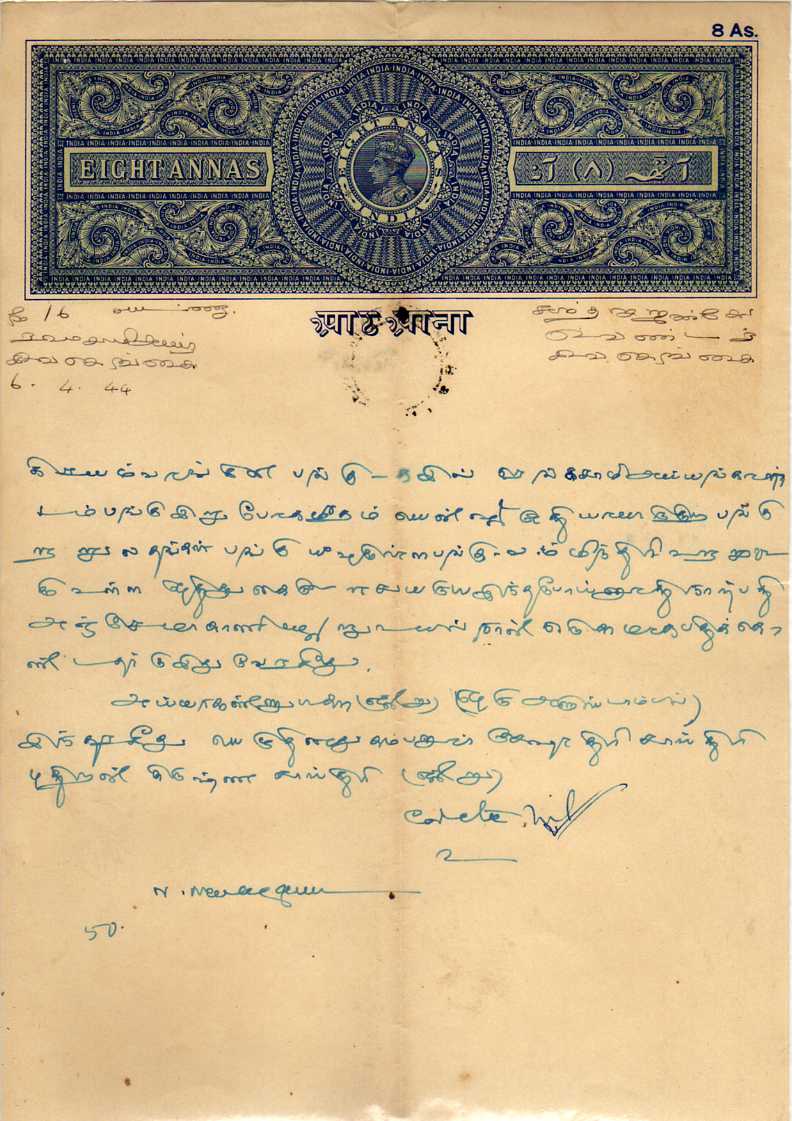
KING GEORGE VI EIGHT ANNAS STAMP PAPER


KING GEORGE VI TWELVE ANNAS STAMP PAPER


KING GEORGE VI ONE RUPEE EIGHT ANNAS STAMP PAPER


KING GEIRGE TWO RUPEES STAMP PAPER


KING GEORGE VI TWO RUPEES EIGHT ANNAS STAMP PAPER


KING GEORGE VI THREE RUPEES EIGHT ANNAS STAMP PAPER


KING GEORGE VI FIVE RUPEES STAMP PAPER


THE ABOVE IMAGES ARE FROM MY OWN COLLECTIONS


INDIA PRINCELY STATE TRAVANCORE STAMP PAPER

SOME OF MY INDIA PRINCELY STATE TRAVANCORE STAMP PAPER COLLECTIONS.

TRAVANCORE THREE RUPEES EIGHT ANNAS STAMP PAPER


TRAVANCORE TWO ANNAS STAMP PAPER


TRAVANCORE THREE AND HALF CHUCRAMS STAMP PAPER


TRAVANCORE ONE RUPEE EIGHT ANNAS STAMP PAPER


TRAVANCORE THREE RUPEES STAMP PAPER

TRAVANCORE THREE RUPEES STAMP PAPER


TRAVANCORE TEN RUPEES STAMP PAPER


TRAVANCORE THREE RUPEE EIGHT ANNAS STAMP PAPER & 1/4 RUPEE COURT FEE


TRAVANCORE EIGHT RUPEES STAMP PAPER & 1/4 RUPEE, ONE FANAM COURT FEE

UNITED STATE OF TRAVANCORE & COCHIN 35 RUPEES STAMP PAPER


TRAVANCORE FOUR RUPEES STAMP PAPER& 3 HALF RUPEE, ONE TWO CHUCKRAM, ONE FANAM COURT FEES.


TRAVANCORE 20 RUPEES STAMP PAPER & TWO HALF RUPEE, ONE FANAM COURT FEE


TRAVANCORE VERY RARE 171/2 RUPEES STAMP PAPER WITH COURT FEE

TRAVANCORE ONE CHUCKRAM STAMP PAPER


TRAVANCORE 71/2 RUPEES STAMP PAPER WITH FANAM COURT FEES


THE ABOVE IMAGES ARE FROM MY OWN COLLECTIONS